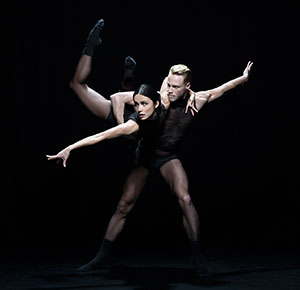
 Photo – Wendell Levi Teodoro
A black space, a white screen hangs above. Four white illuminated lines form a frame. A violinist takes her place. From the darkness, light: a melodic weaving, the climb and fall of scales as they slide and melt. Precise and agile, a body moves, reacting, resonating with formal elegance, partners with another body creating physical echoes of JS Bach’s Violin Partita No. 2 in D Minor.
In Rafael Bonachela’s latest work 2 in D Minor, the tradition of Bach’s intricate and restless melodic themes is transposed into the dancer’s body in a display of aristocratic maximalism. A suite of actions provides a physical “response” to the violinist’s “call.” Technically crisp and clear, movements responding to individual dancers personal experiences are repeated to a point of visual exhaustion. Bonachela’s note on choreography and costume collides with the experience in an unfavourable way. The intent on a non-gender specific costume leans into the masculine form, denying a connection of the personal or feminine within the female performers. Experience is translated into expression, but abstracted into uniformity in the process, presenting not a unique and individualistic emotional experience, but a homogenization. Movements are measured – not built upon in pace or intensity, but to the degree that exact repetition is it’s own reward. Each suite of Bach’s Violin Partita No. 2 in D Minor is punctuated with fierce and fizzing “sound clouds” composed by Nick Wales, creating an abstract response to Bach’s neat structure. This punctuation extends the conversation between music and movement, ultimately lifting the work out like an spiral of fibonacci numbers, from the expected and the usual, climbing steadily and barely resting.
Restlessness might be an underlying theme or modus operandi within the Sydney Dance Company – commissioning eight new works to celebrate their 45th Anniversary – two of which appear in Interplay’s triptych – 2 in D Minor choreographed by Bonachela and L’Chaim! choreographed by Gideon Obarzanek.
The second piece in the evening’s program is a revistation by Jacopo Godani’s critically acclaimed 2011 work Raw Models. A heavy, pulsating, portrait fuelled by animalistic urgency, sexual power and primitive survival, Raw Models is a muscular intense exploration of the natural versus the constructed in human motivation. Dark, sensual and unyielding, Godani’s work combined regimented action with moments of lithe and heated confrontation. Music by 48nord (Ulrich Müller und Siegfried Rössert) is a blend of electronic sounds, instrumentation filtered, mixed, layered and transformed into a composition which according to their program note “would not be possible to do live.” Atmospheres punctuated by shadows and hiccups of brilliant light, this work is undeniably powerful, eye-catching and relentless.
Lastly, Gideon Obarzanek’s L’Chaim! offers a completely different experience. Although using a lighter palette of colour, sound and text, the overall affect is equally as dark and considered as the previous instalments in Interplay. Music by composer Stefan Gregory builds from a place of repetition to an ecstatic burst of traditional dance. David Woods provides a line of textual interrogation performed by actor Zoe Coombs Marr asks questions of a philosophical nature about the very meaning and origin of dance practice, dance aesthetic and a dance career – an interrogation held whilst the company jump and jiggle in precise formation, a gruelling act of restless, visually exhausting movement, which though athletic and ordered ultimately presents the rudiments of dance at its most casual. This irreverent self-conscious jumble of caricatured tropes, glib responses, puns and brutal simplistic self reflection ultimately boils down to “joy.” However, is that meat enough in this particular tri-part presentation of “playfulness” or is it an easy pathway into popularity through being obvious? The weight of dance history, the skill and the tenuousness and fragility of the dancer is bludgeoned by text and cutesy gimmicks, leaving nothing but sour and simple taste in my mouth that dance is brutal, to subvert one’s artform into the obvious and entry level understanding of human existence is ultimately cruel and ungrateful, and perhaps that’s what artists ultimately are?
Interplay is an intriguing suite of works by Sydney Dance Company full of experimental expression, philosophical questioning and casual elegance. Each section offers an exploration into the body’s relationship to sound and space and offers much to chew over post-event.
Sydney Dance Company presents
INTERPLAY
Choreography by Rafael Bonachela, Jacopo Godani, Gideon Obarzanek
SYDNEY – 15 March–5 April, Sydney Theatre
CANBERRA – 10–12 April, Canberra Theatre Centre
MELBOURNE – 30 April–10 May, Southbank Theatre
See sydneydancecompany.com for more details
Sydney Reviews
Interplay | Sydney Dance Company
- Details
- Augusta Supple
Most read Sydney reviews
The Lark | Hey Dowling
Noni Hazlehurst brings Rose and The Lark to colourful and compelling life in this one-woman show.
Pride & Prejudice* (*sort of) | Neil Gooding Productions & Woodward Productions
This rollicking musical take on Jane Austen’s beloved novel is a side-splitting crowd pleaser.
Heartbreak Hotel | EBKM
Heartbreak Hotel invites its audience into an intimate portrait of the universal and isolating experience of heartbreak.
Current | Sydney Dance Company
While Bonachela’s work is, as always, dreamily lovely, for me the highlights were absolutely the three commissioned choreographers: Azzam Mohamed, Jenni Large and Raghav Handa.
The Gospel According to Paul – The Second Coming | Soft Tread Productions
The Gospel According to Paul is meticulously crafted entertainment. It’s uplifting without pulling any punches.
The Gospel According to Paul is meticulously crafted entertainment. It’s uplifting without pulling any punches.

While Bonachela’s work is, as always, dreamily lovely, for me the highlights were absolutely the three commissioned choreographers: Azzam Mohamed, Jenni Large and Raghav Handa.